New Works @ the Walker
On Resolving the Problem of Representation
“New mediums gave rise to considerations of how painting and painters might respond.” A trio of works demonstrate that painting’s engagement with photography and film continues to reverberate, finds Mike Pinnington…
Prior to the 19th century arrival of photography, painting had been the undisputed visual recording device. It wasn’t, of course, always truthful. Nor was it democratic. Gentry and royalty – those able to pay for the privilege – would be flattered; a nip here, a tuck there, long before plastic surgery made such terminology commonplace, and longer still before editing software and apps made aesthetic tweaks the norm. With the possibility of near instantaneous image capture, painting’s role came under scrutiny. As one commentator said in 1839, photography was: “an invention… which could cause some alarm to our Dutch painters. A method has been found whereby sunlight itself is elevated to the rank of drawing master, and faithful depictions of nature are made the work of a few minutes.”
Subsequent decades saw the birth of cinema (with the Lumière brothers holding the first ticketed screening of moving pictures in Paris, in 1895). And, as the next century dawned concerns grew, moving the artist Henrietta Clopath to remark in 1901 that: “The fear has sometimes been expressed that photography would in time entirely supersede the art of painting. Some people seem to think that when the process of taking photographs in colors has been perfected and made common enough, the painter will have nothing more to do.”
The rumours of painting’s impending death, however, had been greatly exaggerated. As we know, while its viability is periodically questioned (not least today), rather than its being superseded, what happened instead is that painters adapted to, were catalysed even, by the perceived threat. The new mediums of photography and film gave rise to considerations of how painting and painters might respond; either by going beyond the old tradition of performing the role of mirror on the world, or in open dialogue.
Writing on the conversation between film and photography, David Campany has said that the mediums remain significant for each other, “not just technically but aesthetically and artistically. Each has borrowed from and lent to the other. Each has envied the qualities of the other. And at key moments each has relied upon the other for its self-definition.” The exact same can said of painting, in view of such technological arrivistism. Painting’s engagement with both photography and film, at times simultaneously, continues to reverberate through the discipline, a point richly demonstrated by a trio of contemporary works now on display at Liverpool’s Walker Art Gallery.
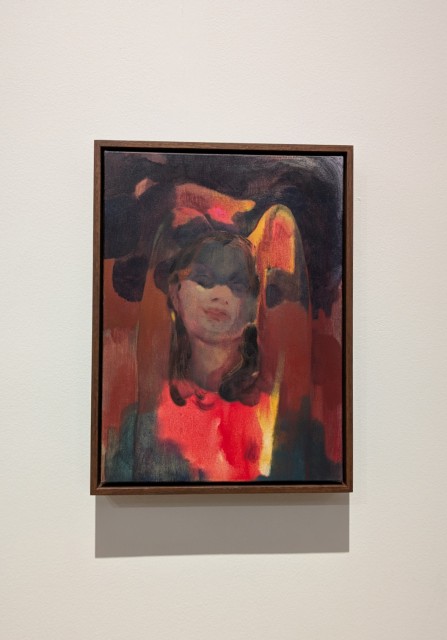
Via the woozy ambiguity of Eva Helene Pade’s 2025 painting, I mørket (In the dark), we are transported back to early 20th century Germany and the expressionism that represented a conscious move to address the challenges posed by new means of capturing the world. Marked by an urge to represent emotion, interiority and spirituality as opposed to facsimile, from Kandinsky to Schiele, Munch to Dix, this was a movement delving deep beneath the surface of its subject matter. Often, these were paintings of women – either muse or hysterics – by men. In the case of Pade’s modern-day take, however, in work she has described as a ‘surrender to the more metaphysical parts of the paintings,’ we find an artist depicting active female protagonists rather than passive subjects. I mørket (In the dark) – vivid, and the longer you look at it, somehow destabilising – feels at once fresh, relevant and literate.
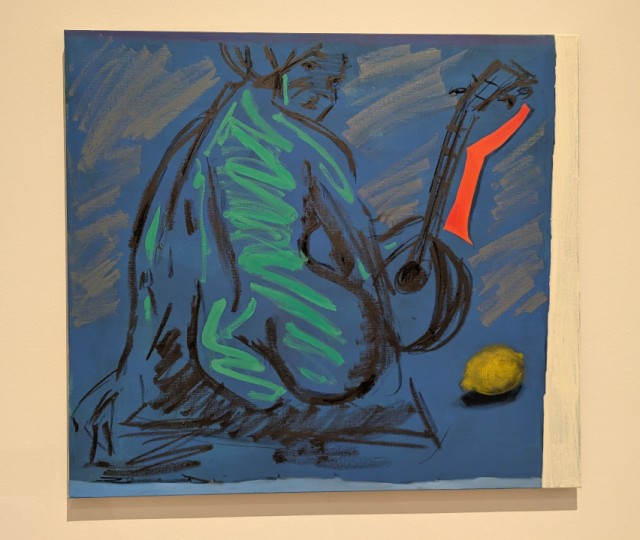
Ella Kruglyanskaya, an artist who said that she wants her paintings to feel cinematic, is contending with the canonical problem of the representation of women. Her 2024 work, Odalisque in Blue (small) – featuring a naked female figure viewed from behind, looking back at us over her shoulder – finds Kruglyanskaya referencing the intersectional issues contained within the ‘Orientalist’ movement’s objectification of enslaved women. Situating representation of women in a contemporary context, her paintings blur disciplinary lines between art, illustration and the ubiquity of social media image-making. Speaking in a 2016 TDN interview about the sources and themes that proliferate in her practice, she said: “pop culture, art history, the history of painting, and the culture of cinema, photography – I think they all play into each other, back and forth.”
Gilles Deleuze has said that “The encounter between two disciplines doesn’t take place when one begins to reflect on another, but when one discipline realizes that it has to resolve, for itself and by its own means, a problem similar to one confronted by the other.” Along with the breadth of cultural reference points, what we see most often in the paintings of Ella Kruglyanskaya, which imply a tussle towards resolving the problem of representations of women, is a resolute decision that her women can rarely be construed as mere subjects of the gaze – a gaze often returned with a large helping of knowing side-eye. As Laura Robertson has observed: “the Female Gaze in Kruglyanskaya’s work stares right back.”
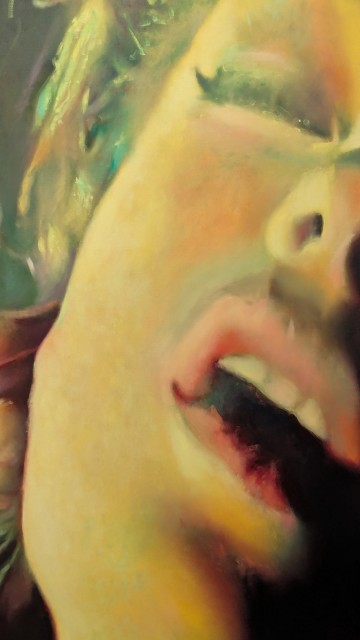
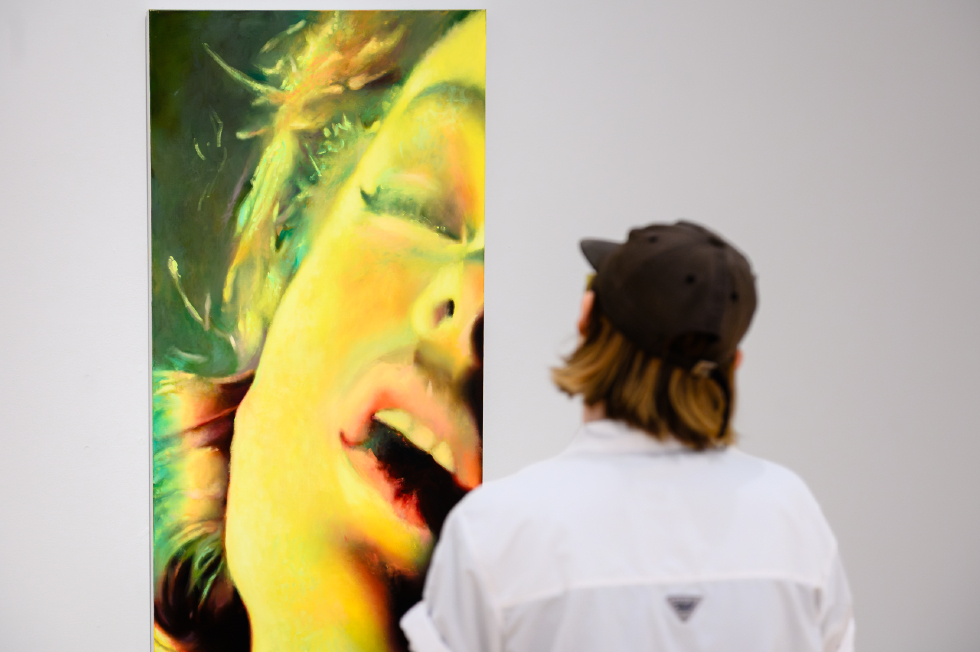
The language of cinema is more explicit still in Mise en scène (2025), a luminous and seductive painting by Louise Giovanelli. Drawn from a found image of a 1970s film, its title, from the French, means ‘to place on stage’, and refers to the means by which visual elements are arranged in a film – including props, the set and, of course, actors. In Giovanelli’s painting, the camera’s lens lands on and captures a woman seemingly amidst, lost even, in pure ecstasy. Superficially at least, it suggests a particular reading, one of sexual pleasure. In fact, belying assumptions borne of a lifetime’s worth of mainstream portrayals of women on screen, she is delighting in another act, that of taking communion.
The spectre haunting each of these works and, indeed, this piece of writing, is neither photography or film, but Laura Mulvey’s 1975 essay, Visual Pleasure and Narrative Cinema, which introduced the theory of the ‘male gaze.’ In a later, 2003 essay, Stillness in the Moving Image: Ways of Visualizing Time and its Passing, Mulvey wrote: “I was preoccupied by Hollywood’s ability to construct the female star as ultimate spectacle, the emblem and guarantee of its fascination and power. Now, I am more interested in the way that those moments of spectacle were also moments of narrative halt, near stillness, that figure the halt and stillness inherent in the structure of celluloid itself. Then, I was concerned with the way Hollywood eroticized the pleasure of looking, inscribing a sanitized voyeurism into its style and narrative conventions. Now, I am more interested in the ways in which the presence of time itself can be discovered behind the mask of storytelling.”
Mulvey goes on to say that “new technologies allow the spectator time to stop, look and think.” But Giovanelli (and others channelling similar concerns), demonstrates that ‘old’ technology can be equally adept at providing that space; in the stillness of painting can be found a space that takes us beyond (the albeit still relevant) ‘woman as image’ narrative this trio of works might at first suggest.
Mike Pinnington
Works discussed are on display in the Walker Art Gallery‘s Contemporary displays
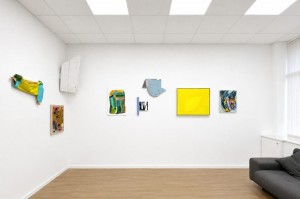
Images, from top: Installation view of Louise Giovanelli, ‘Mise en scène’ (2025) at Walker Art Gallery © Pete Carr; other installation shots: Eva Helene Pade’s 2025 painting, I mørket (In the dark); Ella Kruglyanskaya’s 2024 painting, Odalisque in Blue (small); and Louise Giovanelli’s 2025 painting, Mise en scène, all MP