ARTIST ROOMS: Ed Ruscha – Reviewed
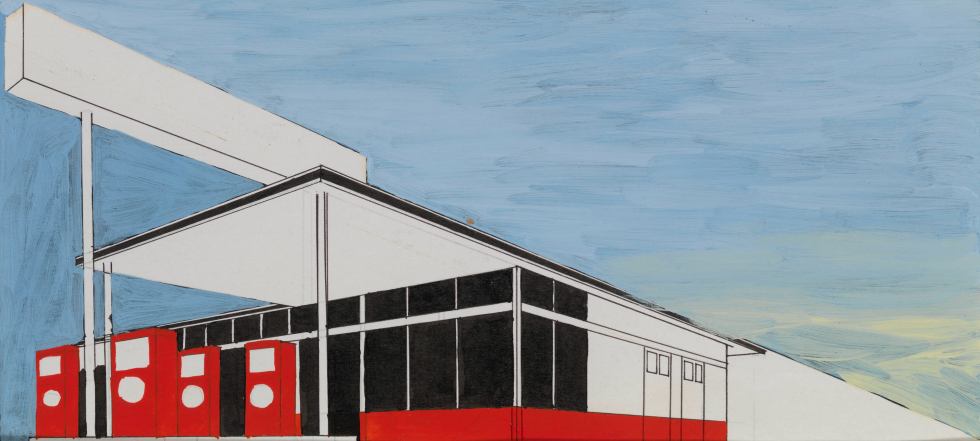
The great American road trip – the frontier and its trappings – serve as departure point for artist Ed Ruscha, and this tightly focused exhibition of his works, finds Mike Pinnington…
In 1956, Ed Ruscha – an artist JG Ballard said had ‘the coolest gaze in American art’ – embarked on a journey that, in many ways, would foreshadow a career and its concerns to follow. Leaving his Oklahoma City birthplace behind, he made his way west, driving along dusty highways and byways, to Los Angeles. En route, he was struck by the stark expanse of the landscape.
Signs of life came mostly in the form of gas stations, those uncanny waystations which punctuated his trip and the liminal spaces along the storied Route 66. Many of these he would capture with his camera, resulting in the photographs that led in 1963 to his first, now iconic artist book, Twentysix Gasoline Stations (as well as an accompanying series of paintings, drawings and prints). These works speak to the great American road trip – the frontier and its trappings – and serve as departure point for a close, ongoing engagement with the signs and symbols of the US.
From its landscape and self-image (commonly projected onto the silver screen) – all of it a reflected, blurry version of what used to be called the American dream – Ruscha’s work gives us a front-row seat, inviting us along for the ride. Such aspects are brought together in tight focus in Tate Liverpool’s ARTIST ROOMS: Ed Ruscha.
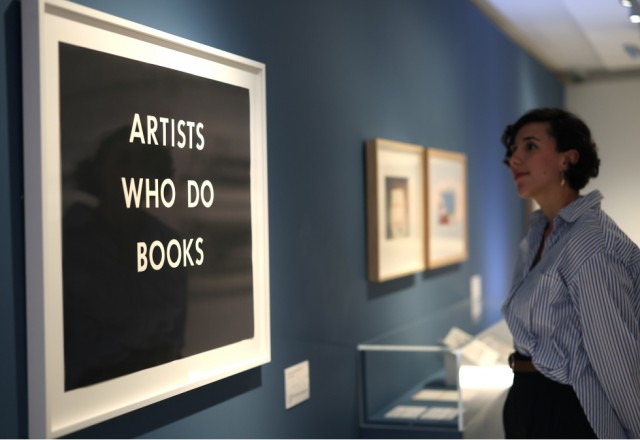
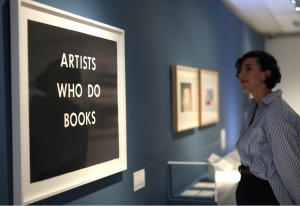
The artist has said: “When I got going on the books … it was really the red meat of my work.” Fittingly, then, the show begins with the handsome ARTISTS WHO DO BOOKS (1976), a monochromatic black and white work on paper that reads as declaration of intent, and as a reminder of Ruscha’s beginnings and continuing interest in graphic design. Nearby, a vitrine protects, among other items, second and third editions of Twentysix Gasoline Stations; above it, a 1970 lithograph presents a framed tactile-looking depiction of the book. If the constraints of viewing printed matter in this way frustrate somewhat, an adjacent digital display allows for a relaxed, leisurely look at this and other publications that echo throughout the following works herein.
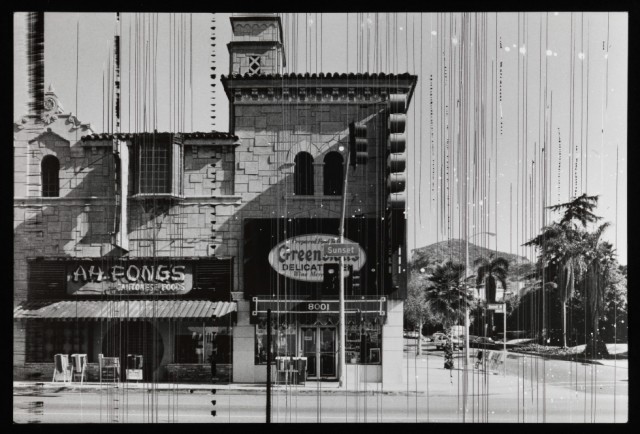
From route 66, we nose our way through West Hollywood, arriving at the Sunset Strip. Drawn from photographs made in 1966 for Ruscha’s book Every Building on the Sunset Strip (a series he revisited in 1995), the examples on display here invoke nothing if not the locale’s mythology. Shimmering with the heat haze of the blazing California sunshine, they call to mind movies made – and, no doubt, merely dreamt and imagined – here, at such industry haunts as Greenblatt’s Deli. Reminding us of Hollywood’s genius and propensity for artifice, Ruscha used razor blades and sandpaper to simultaneously deface and emphasise the filmic quality of these images.
Cinema and its history is rich subject matter for artist and audience. In Pools #1–#9 (1968), we recall the moneyed leisure/ennui on show in The Swimmer, made the same year. Frank Perry’s picture finds Burt Lancaster’s Ned Merrill swimming home via neighbourhood pools on a journey of middle-aged existentialist self-discovery. 1975’s semi-abstract Miracle #64, meanwhile, is at once shaft of celestial projector light, and a foreshadowing, at least to my mind’s eye, of David Lynch’s then yet to be made film, Lost Highway (1997). In that, it somehow suggests, perhaps even informs, and is drawn into, the mobius strip time loop of that film’s narrative; the two somehow meet along the road, to become fellow travellers, emphasising the enduring and fruitful conversation enjoyed between art and film.
Elsewhere, tools of the graphic design trade are once again to the fore; in Los Francisco San Angeles Portfolio (2001) and BLVD.-AVE.-ST. (2006), we see small- and large-scale experimentation with geometric patterns and grid systems the artist calls ‘metro plots’. With PAY NOTHING UNTIL APRIL and DAILY PLANET (both 2003), Ruscha enlists his wonderfully named Boy Scout Utility Modern typeface, in ambiguous, intertextual works – one seemingly a reference to delaying the inevitable, the other environmental and pop culture comic book reference both – juxtaposing the text of their titles with vast mountainsides.
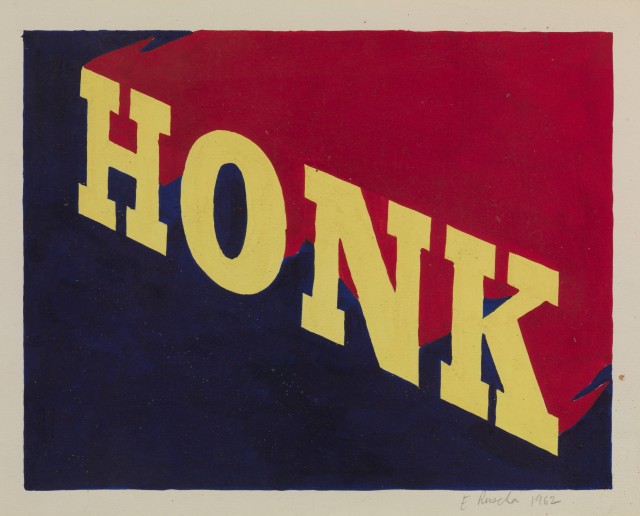
In the onomatopoeia of HONK (1962), we are brought neatly back to that grand North American symbol of liberation, the means by which Ruscha became Ruscha, the automobile. MAD SCIENTIST (1975) and HOLLYWOOD TANTRUM (1979) imply La La Land tropes – on-screen and off – touching yet again on visual art’s complex relationship to cinema. Like many a great film, ARTIST ROOMS: Ed Ruscha, is over before you know it; not, however, before one final nod in the direction of the intersecting of life and the movies, with the irresistibly apt – forgivably on-the-nose – selection of THE END #40 (2003). A staple of closing credits, it serves here as marker of the close of this exhibition – while leaving you yearning for an extended director’s cut.
Mike Pinnington
Artist Rooms: Ed Ruscha continues @ Tate Liverpool until 14 June
Images: Ed Ruscha, Standard Study # 3 1963 © Ed Ruscha; Edward Ruscha, ARTISTS WHO DO BOOKS 1976; Ed Ruscha, Greenblatt’s Deli (Sunset Strip Portfolio) 1976, printed 1995 © Ed Ruscha; Ed Ruscha, HONK, 1962. ARTIST ROOMS Tate and National Galleries of Scotland. © Ed Ruscha