Creature, Stranger, Monster, Other: A Photography Conference – Reviewed
Jessie Tam reports on a “compelling” conference at the University of Greater Manchester, which turned a critical eye to the ethical and practical complexities artists face working as The Other – and when they collaborate with peoples and knowledge that is underrecognised, marginalised, excluded, or transforming…
Bringing together fourteen artists, researchers, and practitioners in Bolton for a series of fifteen-minute presentations, Creature, Stranger, Monster, Other: A Photography Conference explored photographic practice in relation to ‘the Other’. Co-convened by University of Greater Manchester staff, writer Laura Robertson, photographer Roxana Allison-Eguiluz, and philospoher Professor Jill Marsden, this was the first photography conference held by the university in ten years, and positioned photography as a practice connecting personal experiences with wider social, political, and cultural issues. The speakers – many early career researchers, postgraduates, or freelancers working with precarious funding or relying on sessional teaching – asked not only who appears in photographs, but also who makes images, who participates in image-making, and how photographic meaning is created collectively.
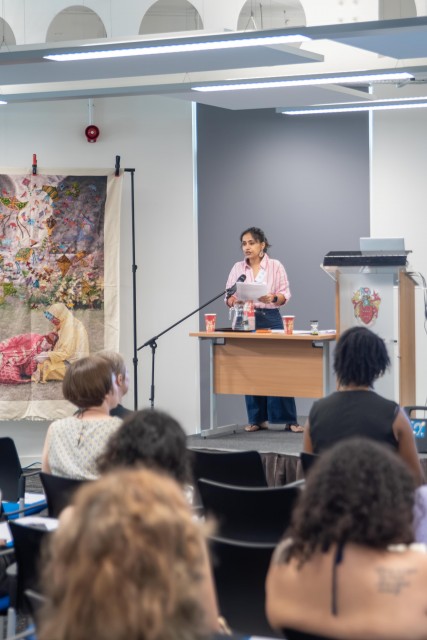
In ‘Women and the Workplace’, lens-based interdisciplinary artist Sujata Setia (pictured, below) introduced her project-in-progress, developed with embroidery artisans in Kashmir, in which she printed photographs onto fabric and invited the artisans to transform the images through stitching. The embroidery became part of the photograph, registering traces of shared labour, artisanal skills, and personal experience. Having received international press and accolades from Wellcome and Sony for her previous collaborative project, A Thousand Cuts, Setia addressed domestic abuse in South Asian communities. Here, she challenges the idea of the artist as the sole author and positions photographic practice as a joint process of image-making and meaning-making.
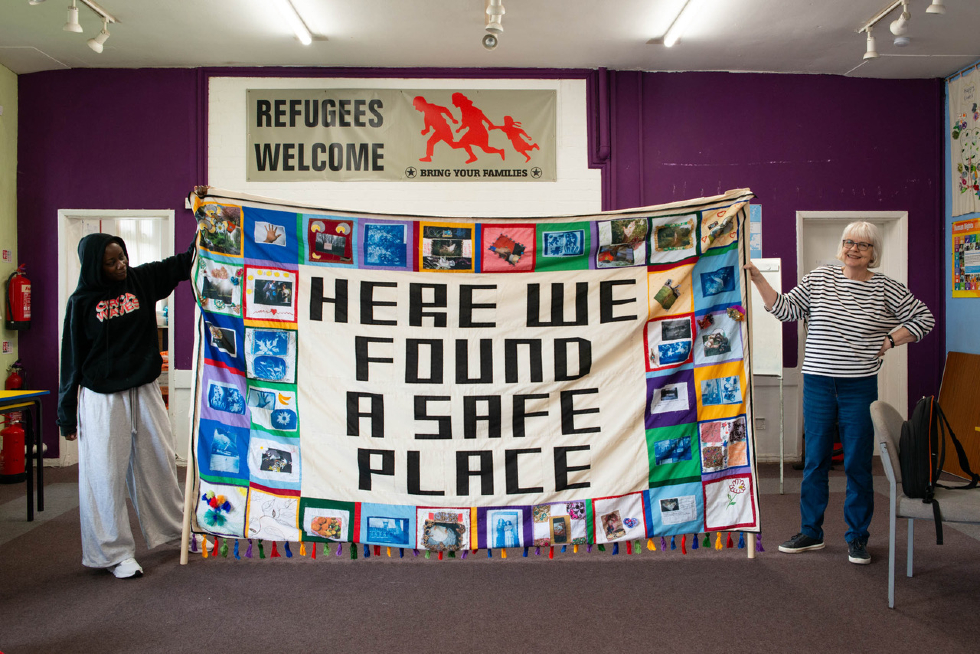
Where Setia focused on shared authorship through co-creating, socially engaged photographer and writer Ciara Leeming (feature image) turned to the ethical and practical complexities artists face when collaborating with ‘the Other’. In a talk entitled ‘Collaboration with the Demonised Other at a Time of Political Crisis’, Leeming shared her experience working with women seeking asylum in Wigan through stitched maps and fabric banners, reflecting on unequal power relations and foregrounding trust as central to photographic practice.
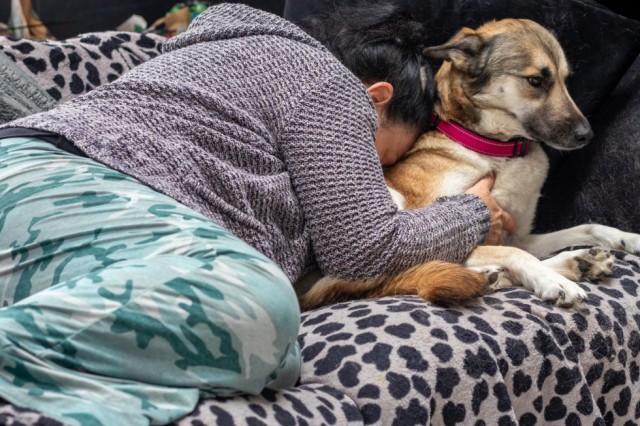
From these questions of shared authorship, the conference began to look more closely at the conditions and experiences of individual lives through photography. In ‘The Carers Who Never Get a Break’, photojournalist and visual storyteller Lois Barnett (below) examined the physical and emotional labour of unpaid carers in the UK. Her photographs follow Colette, who cares for her 96-year-old uncle at home, documenting the routines and small gestures of care, from medication and handwritten reminders to moments of rest. In one image, Colette rests on the sofa with her dog after a long day, offering a quiet moment within the demands of care. Through these intimate observations, Barnett brought attention to both the practical demands of caring and the relationship between Colette and her uncle, while asking why care work remains absent from public and political discussion.
These questions of power and lived experience also became embodied in presentations examining how political forces shape everyday life. Multidisciplinary artist and practice-based PhD student at the University for the Creative Arts (UCA), Zohreh Mohammadhosseinpour’s ‘Not Freedom, On Freedom: Iranian Women’s Bodies Are Shaped and Controlled Through Political Power’ discussed how political power governs women’s bodies and everyday experiences through photography, text, video, and sound. Drawing on post-revolutionary Iran and her own family photographs, Mohammadhosseinpour used a documentary and conceptual approach to examine the body as a living archive, holding personal stories yet enduring experiences within histories of memory and family relationships that continue to influence the present.
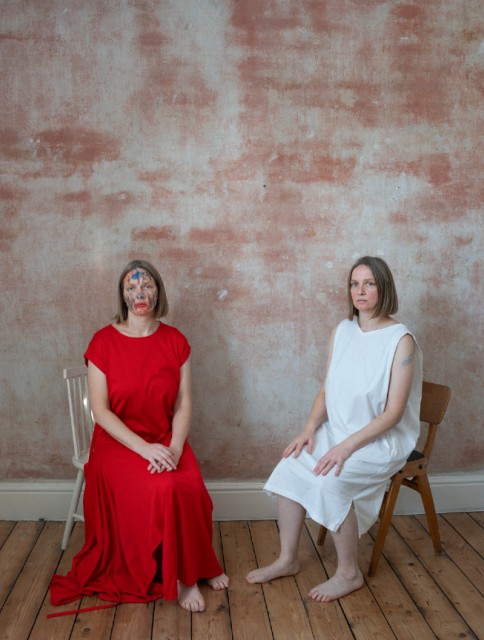
Other presentations approached the body through gender, ageing, motherhood, and trauma. Through performative photography, artist and University of Dundee practice-based PhD researcher Nicky Riding challenged stereotypes surrounding menopause and ageing in ‘Monstrous Middle-Aged Women’. Photographer Lāsma Poiša (below), meanwhile, explored her experiences of traumatic birth in ‘The Mother and the Monster: Photography and the Abject Maternal’, reflecting on how motherhood reshapes memory, emotion, and identity through photographic documentation.
The question of embodiment then extended beyond the human. Artist and Senior Lecturer at LJMU Marc Provins expanded the discussion through walking, scanning, and experimental image-making. In ‘Creaturely Queer Bodies: Peripheral Drift In Contemporary Photographic Practice’, Provins used a handheld scanner to capture fragments of skin, plants, and domestic surfaces, which he assembled into distorted, collage-like images. These images blur the boundaries between bodies, technologies, and environments, opening up embodiment as something changed through relationships between human and non-human worlds.
This shift opened up a different understanding of collaboration, extending it beyond human relationships to materials, environments, and more-than-human beings. Rather than treating photography as the product of human beings alone, these presentations raised questions about image-making as a process emerging through encounters between materials, technologies, and ecological systems.
Drawing on new materialist and posthumanist perspectives, artist Lizzie King explored photography through natural materials, sound, and ‘quantum listening’ in ‘How Do We Turn Strangers Into Kin: A Case Study in Co-creation With Other Creatures’. Her presentation engaged with common and invasive plant species, including Himalayan Balsam, and aquatic insects such as water boatmen. Using photography and sound, King recognised materials and ecological processes as active participants in image-making, suggesting new ways of producing photographic knowledge. Photographic materials are not neutral. They hold histories, meanings, and cultural significance, which artists can uncover through the ways they handle and transform them.
In his short animated film ‘Captain Cook Is Dead’, artist and Sustainable Darkroom advocate Edd Carr traced how colonial histories remain embedded in photographic materials and the landscapes from which they come. Using oak foraged from Cook’s home, the North York Moors (NYM), Carr incorporated the material history of the land into inks and prints within the film, connecting local histories of the privatisation of common land with colonial expansion and extraction. In this film preview, ahead of festival premieres later this year, Carr showed how photographic materials can trace the worlds they originate from, revealing colonial histories alongside those of the images they produce.
Curator, visual artist, and Founding Editor of No! Wahala Magazine, a contemporary photography magazine dedicated to showcasing authentic visual stories told by African creatives, Anne Nwakalor turned to the language of photography. In ‘Photography Was A Colonial Tool’, she questioned colonial and militaristic terms embedded in words such as ‘shoot’, ‘take’, and ‘capture’, and proposed alternatives such as ‘photographing’, ‘documenting’, ‘preserving’, and ‘making’. Together, these presentations showed how colonial histories continue to influence photographic practice through its materials, language, and methods of making. They invited us to recognise these histories as a starting point for reimagining photographic practice.

These questions of power led back to the archive, often seen as a neutral place for preserving the past. Here, however, the conference considered how archives also retain photographic knowledge through ownership, access, and preservation.
Journalist, critic, and ArtReview editor Oliver Basciano took this question of the archive further in his presentation, ‘Opening the Bird Cage: The Japanese Leprosy Hospital Through the Photography of Cho Kunje’, which introduced the work of Japanese-Korean photographer Cho Kunje (above). Expanding on his first book, Outcast, which won the RSL Giles St Aubyn Award for Non-Fiction, Basciano painted a picture of how Cho lived and worked alongside people interned in Japanese leprosy sanatoria for decades.
Cho photographed everyday life, friendships, hobbies, and political activism, foregrounding agency and lived experience rather than illness alone. The presentation also followed the ongoing process of opening Cho’s archive beyond Japan. Making the photographs publicly accessible required written consent from those represented.
Opening an archive involves more than making photographs publicly available. It also acknowledges the care and trust that are part of making them in the first place.
What made Creature, Stranger, Monster, Other particularly compelling was not only the diversity of ideas, but the way individual presentations developed and spoke to one another. Photography emerged not simply as a collection of fixed objects, but as a social and material process formed through making, circulation, and use. While there is no single answer to who becomes the Other, the conference showed how we might rethink who makes and contributes photographic meaning, and how photographs connect us with people, materials, and the worlds we inhabit.
Jessie Tam
Jessie saw Creature, Stranger, Monster, Other: A Photography Conference on 26 June 2026 at the University of Greater Manchester, Bolton, UK
Image credits from top: Ciara Leeming, SWAP project banner, commissioned by Open Eye Hub, a partnership between Open Eye Gallery and Wigan Council, 2024-25
‘Women and the Workplace’, lens-based interdisciplinary artist Sujata Setia. Creature, Stranger, Monster, Other: A Photography Conference 2026. Image credit Rian Murray
Lois Barnett, Colette, from The Carers Who Never Get a Break, 2025-ongoing. Courtesy the artist
Lāsma Poiša, The Shadow, from I became a mother, 2022-ongoing. Courtesy the artist
From Oliver Basciano’s talk: Cho Geun-jae, A short rest, Nagashima Aiseien, 1970. Courtesy National Hansen’s Disease Museum, Tokyo