Studio Series: Printmaker and Artist Ryan McClelland
In our visit to his home studio in North London, Liverpool-born artist Ryan McClelland reflects on his slow, painstaking practice: carving, printing and layering disparate images of British culture – from Myspace mirror selfies, to IKEA riots, to Hillsborough disaster press coverage…
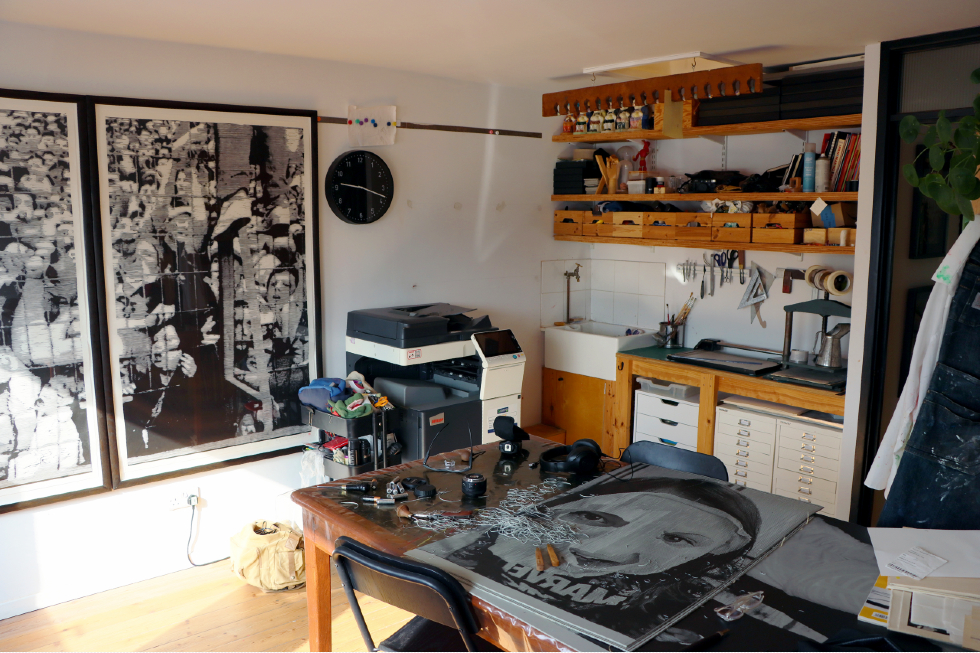
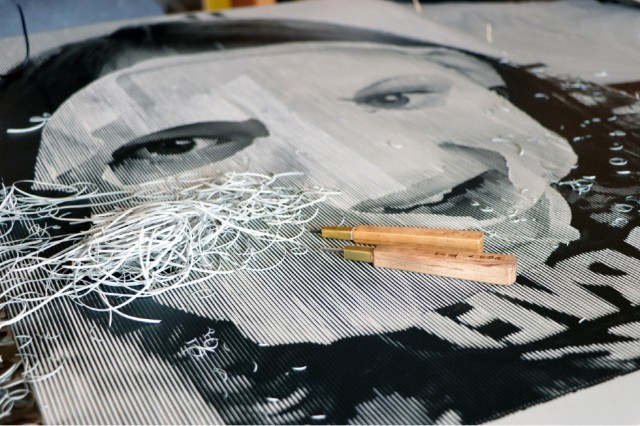
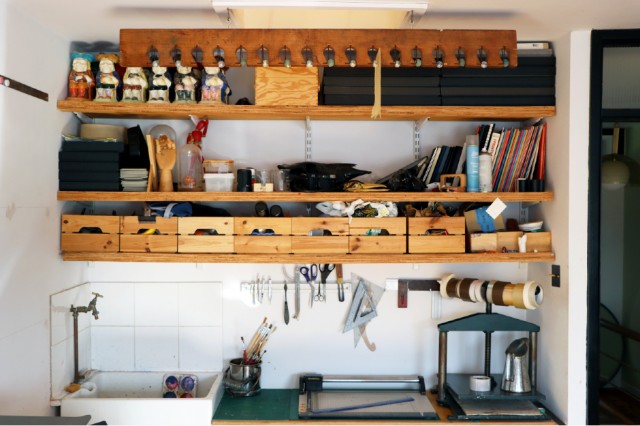
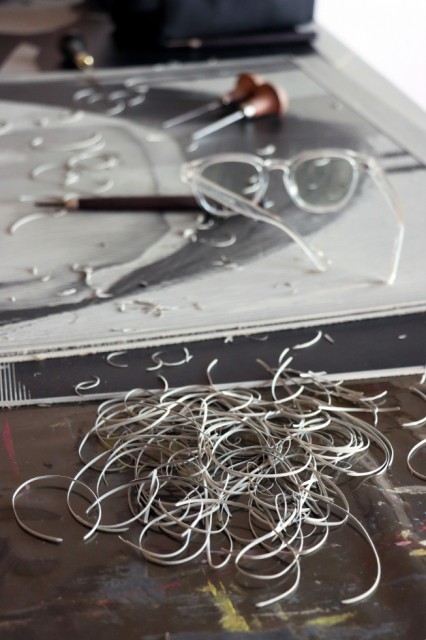
Lino cut curls cover tables and floor alongside A4 reference photographs, prints hang from pegs, and framed, wait in handmade storage boxes ready to be shipped; artist Ryan McClelland’s home studio hums with quiet productivity. Originally from Aintree, but based in London since the mid-1990s, he lives with his wife, Leah, son, Sammy, and dog, Winnie in RedBrick House, Haringey.
Specialising in dramatic, large-scale relief prints, McClelland is interested in – amongst other things – the replication and circulation of imagery from news, media, archives, and degraded or damaged digital files.
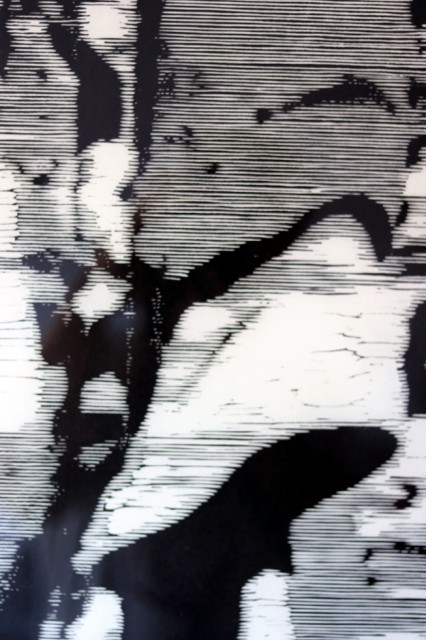
The resulting print work, cut out of lino, inked and pressed onto paper, is a breadth of black-and-white, distorted cultural focal points: on everything from the Grand National – a reference to growing up in the eighties a stone’s throw away from the still hugely popular but much protested racecourse, which often leads to the death of competing horses; early noughties Myspace mirror selfies, full of asymmetrical fringes and digital camera flashes (of which he’s made a zine); to the 2005 IKEA riots, in which he depicts North Londoners fighting over £45 sofas in the car park; to recollections of the 1989 Hillsborough disaster press coverage, addressing the front pages that demonised fan conduct, and their haunting legacy, into cuts.
An alum of MA Fine Art Printmaking at the Royal College of Art (2004–2007), following earlier studies at Goldsmiths and Camberwell College of Art, McClelland was Print Fellow at the Royal Academy Schools (2010-12), and his work has been exhibited nationally and internationally at institutions including the Victoria and Albert Museum, London, Palais de Tokyo, Paris, and G39, Cardiff. Recent exhibitions have included Print Out at Lismore Castle Arts, Ireland, and The Current & the Yellow at KASKO in Basel, Switzerland. His work is held in public and private collections across Europe, South America and the United States.
Alongside his studio practice, McClelland has collaborated on educational and public projects with organisations including Tate, Art on the Underground, and Green Man Festival. From 2010-17 he sat on the board of trustees of the charity intoart that supports artists with learning difficulties. Between 2022-26, he curated Cypher BILLBOARD, a public-facing contemporary art project in North London that explored the relationship between art/print, advertising, and public space.
Hi Ryan! Please describe your studio space.
The studio and office take up the top floor of a three-story 1980s ex-council house that my wife and I bought just before Covid and renamed RedBrick. We completely gutted it and reconfigured the layout to create the biggest, brightest room possible as a working space. It has a view across the ever-changing London skyline and, being at the top of the house, feels detached from the domestic life that plays out in the rest of the building.
What work do you do here?
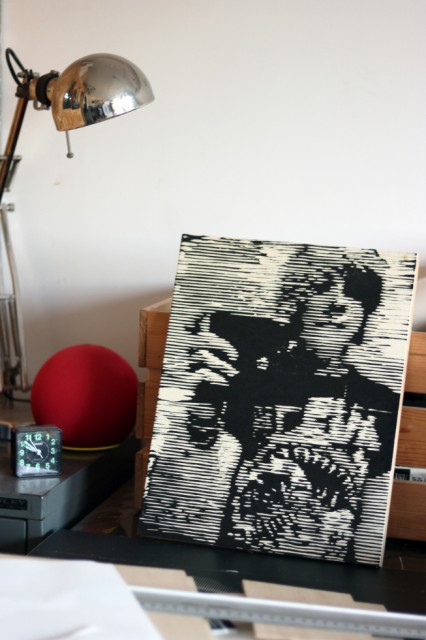
My work has focused on print, drawing and collage for the last decade. I use the smaller office space for drawing and collage, and the larger studio for cutting lino and woodblocks. I tend to edition my work at Muttonfist Press, as using noxious solvents in a domestic setting isn’t ideal.
After a busy summer I have slowly been getting back to the routine of making work. I’m currently working on three large linocuts based on family photographs taken on my iPhone. Images are selected, digitally manipulated and transferred onto block, ready for the cutting stage. It is intricate and laborious, and slips and mistakes are made, which becomes part of the work.
I originally trained in ceramics so think I have a naturally three-dimensional brain; relief print is an almost sculptural process in which you can make 2D images with a small cutting tool. My work is then printed by hand onto very beautiful handmade Asian papers, which brings another layer of materiality to the finished work.
How many hours a week do you spend in the studio?
This is a question I get asked a lot, considering the labour-intensive nature of my work, and it varies wildly depending on teaching and family commitments. If I’m working towards a show, I can put in some very long days and, on the occasional sleepless night, I often find myself back in the studio carving away.
What helps you work?
Having a nice, bright, warm, dry studio is a real luxury. After spending years renting studios across London that usually got sold off to developers after 18 months, having the security of a permanent space that I can access easily means a lot to my practice. Aside from that… music! I’ve got a decent Bluetooth speaker, and because the work can be quite solitary, good tunes keep me going.
What are your three favourite possessions in the studio?
- A ceramic skull made by a former student who sadly died at a young age.
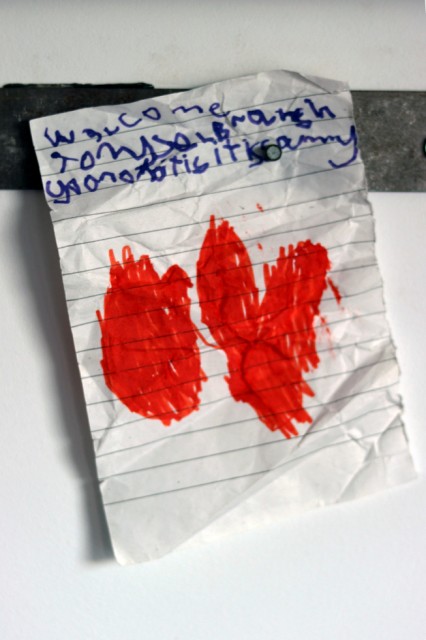
- Handwritten notes from my son when he was a toddler, which I really should get framed.
- My newest toy: a work lamp from Daylight Company that’s hopefully going to help with my failing eyesight.
If your studio could talk, what would it say?
I’m hoping it would say it’s been given a new lease of life. After forty years as a fairly dowdy living space, we’ve completely transformed it as a family. I often joke that the house is like Trigger’s broom in Only Fools and Horses – we’ve replaced or updated pretty much everything so it can function as a live-work space for a 21st-century family.
That live-work relationship has also allowed me to become more ambitious with the scale of my work; at the moment I’m grappling with increasingly large relief prints, including a recent work nearly two and a half metres long, and trying to work out how far I can push what is traditionally quite an intimate, labour-intensive process both physically and technically.
If you had one piece of important advice to give aspiring artists, what would it be?
Just one piece of advice! It’s hard to give just one, but I suppose it would be to stick to your guns. Keep making work regardless of opportunities or other people’s opinions.
As told to Laura Robertson
All photography courtesy Ryan McClelland
See more on the artist’s website: ryanmcclelland.com and Instagram @MrRyanMcClelland