Mirror Selves:
Anthony Shapland – murmur
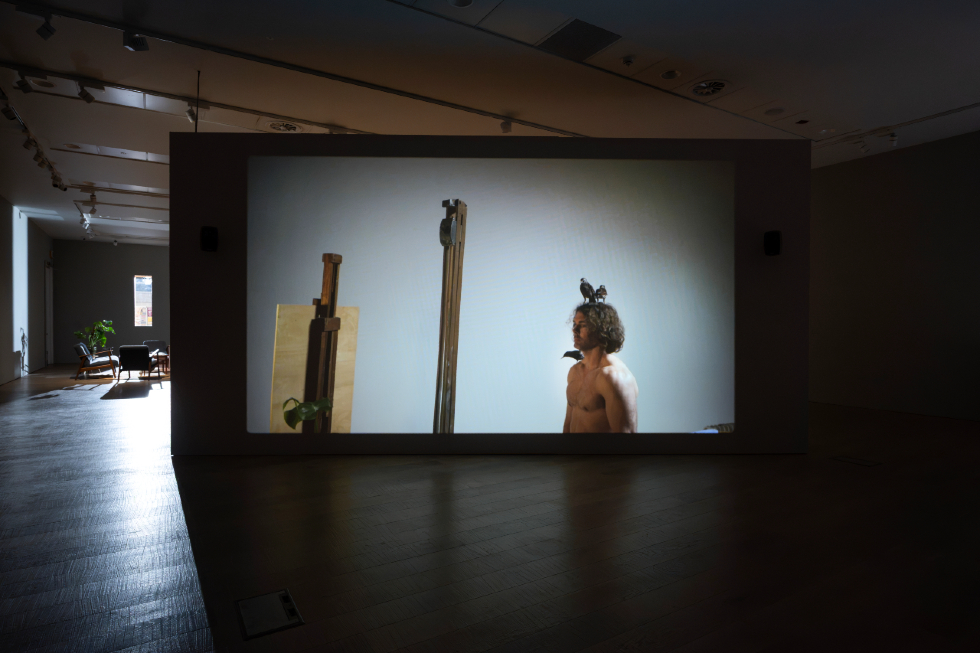
“A low voice. A chant, or a prayer, a rumour. A sound not meant to be heard. Things not to be said.” In murmur, a multi-disciplinary exhibition of film, sound, light and text, artist Anthony Shapland tackles the selves we deny, and the selves we become…
You hear it before you see it; loud, descriptive, cacophonous noise, ricocheting around. What is it? A child’s machine gun imitating the real thing? Beatboxers learning but not yet having perfected their trade? A couple of car alarms? Maybe. No, you think, it’s birds, all kinds of them, such is the racket. Someone must have put some feed out, or some old past their sell by date crusts. It is in fact all and none of these things at once – it’s the starlings. Starlings – our little beatboxers as I’ve come to call them; those rapid, plucky, petrol-inflected birds, just doing their thing, believing perhaps that they must pass as some alternate entity to survive. (According to the RSPB, they are an at risk Red List species.)
In her introduction text to Anthony Shapland’s murmur at Wrexham’s Tŷ Pawb, the exhibition’s curator Marie-Anne McQuay observes that “Starlings are arch imitators. They can replicate the sounds of other birds and their wider environment, including the mechanical noise of traffic crossings and ringtones.” And “in Shapland’s practice these glittering, darting birds stand in for other forms of imitation, for growing up in a rural setting while performing as straight; for almost, yet not quite, fitting in.” Survival by performance.
Fitting in comes naturally to some, less so to others. I’ve always felt, for instance, whether on the periphery of the school disco, or listening rather than taking part in conversation in larger groups, that I occupied somewhat awkwardly (of course awkwardly) the latter, ‘less so’ category. More recently, entering the art sector through a side-door, I was oh so conscious of my working classness (even if I hadn’t yet learned to refer to it as such); to borrow aptly once more from McQuay: I felt “camouflaged and hidden, yet also, somehow, in plain sight.” The mimicry of the starling is an elegant, practically universal, metaphor.
In Shapland’s Wales Book of the Year prize-winning novel, A Room Above a Shop, we are introduced to men used to adopting similar survival techniques, even (especially) when possessed of the yearning knowledge that they should have nothing at all to hide. Should have no need to be wary, on guard. In the opening pages of A Room, we meet B, setting out on his annual pilgrimage, climbing a hill that is “a bright map of his childhood. A play track for stunt bikes, a den, a place to be lost, to disappear with siblings. Or away from them. A place to loiter and mitch dull school days out until the bell. A place to be alone with this feeling that he’s different to the others.” Different: in the wrong hands, such a sly, insinuating term.
Continuing his climb, and mulling over such thoughts, B wonders: “How often has he stared into the mirror at this hidden him? An understudy, carefully learning lines and behaviours; waiting in the wings to take the stage. Trying to understand how it is to be in this small town, a boy in this world.”
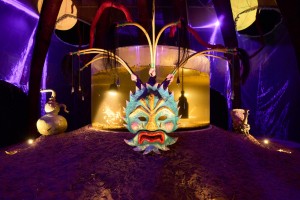
Shapland does not distinguish between his artistic and writing practice. Both relate to his belief that the world is constructed just as a film is, its mise en scène arranged as if by a director; it is natural to visualise B’s train of thought intertwining with murmur’s themes. There we can imagine the words on the page escaping their fictionalised confines, to be made manifest in text (there is a comfortable and considerate reading area amid the installation), audio-visual, and sculptural artworks. A forest – or nest – of easels holds space in the main gallery; beyond which, a film on large-scale screen features a naked man, determinedly holding his pose even when troubled by the occasional winged interlopers – starlings, of course.
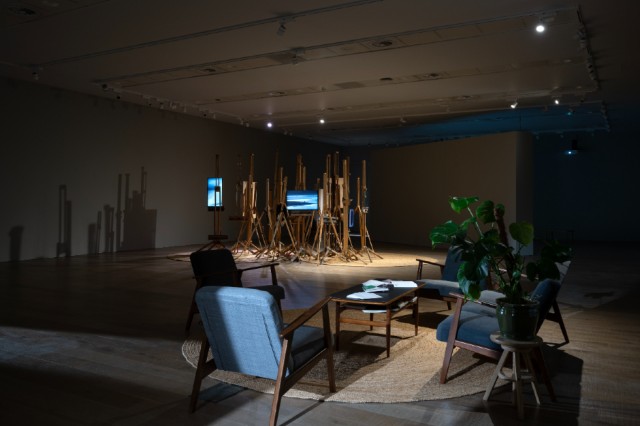
These works acknowledge the mimicry implied, while also speaking to an awakening, a throwing off of the mask, at least in-part, when Shapland left his rural home to go to college (the first in his family to do so), and to his first life-drawing classes. On the easels of Between the Dog and the Wolf (2019) can be found postcard renditions of Sylvia Sleigh’s nudes; these represent, are the result of, a reversal of societal and art historical expectations both. Between the Dog and the Wolf offers cover for a different kind of looking and seeing. In single channel film, Sleeper (2026), meanwhile, we find Sleigh’s 2D work and object of the gaze made flesh (though I’m unsure whether her models ever had to worry about being dive-bombed).
Outside the gallery – subtly playing with our experience of it – Night after night before day’s thoughtful sequencing of light provides a suggestion of the passage of time, and one of the fear and wonder that accompanies twilight; simultaneously, it alludes to night for day, the technique used to simulate night-time film scenes shot in daylight. Elsewhere, the starlings traverse beyond the bounds of the gallery, making welcome appearances in smaller film works dotted around Tŷ Pawb’s covered market. Whether on the lookout, grabbing a coffee, or after locally-made gifts, you’re sure to encounter them. Regular visitors to Tŷ Pawb will be familiar with its piano, atop which there sits sheet music for Tunes for the Starling (1717) – an inclusion that activates and speaks to a meaningful engagement with space as well as, perhaps, the extent to which Shapland feels a certain kinship with these avian proxies.
Elements of autobiography clearly abound, then, but murmur is more nuanced than that – just as life is. It implies the comfortable (and otherwise) wider vocabulary of codes and conduct learned in childhood, and those other codes – often much less familiar – that some wear as snugly as a comfy pair of jeans. It’s found in the cultural capital taken for granted by those from different backgrounds, that the rest must choose to reject or hurry to catch up on – others still oblivious to the race altogether. So while murmur is certainly a self-portrait of sorts, it is also a generous rumination and commentary on social mores – and their many built-in pitfalls. As such, we are all likely to glimpse shards of our own mirror selves therein; remembering those old learned lines as we go, spying fragments of our once-exiled wild twin.
Mike Pinnington
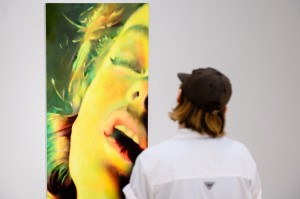
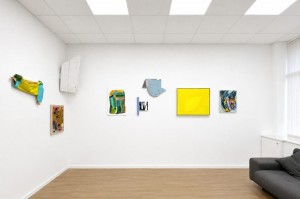
Images: Murmer, Anthony Shapland. Installation view, Tŷ Pawb, 2026. Photos by Harry Meadley
Anthony Shapland – Murmur, until 31 October @ Tŷ Pawb, Wrexham