
Prescient and Poignant: The Man Who Fell to Earth at 50

An out-of-this-world lens on America’s dark heart, Nicolas Roeg’s The Man Who Fell to Earth is back in cinemas on the occasion of its 50th anniversary. How has it faired, wonders Mike Pinnington…
Nicolas Roeg’s 1976 film, The Man Who Fell to Earth, opens in a manner not unlike a typical Western. A mysterious stranger wearing black arrives in an arid environment as if from nowhere; it is a ramshackle, broken down place, strewn with tumble-weed and remnants of buildings. The hulk of an old steam train lies ruined; civilisation, of sorts, lies just over the horizon. But our man in black is not there to rid the town of its corrupt sheriff, or rogue gunslinger; neither is he going to lead a posse to chase down any other troublesome varmints. This is avowedly not a Western..
If you’ve seen the film or read Walter Tevis’ book from which it was adapted, you’ll know that The Man Who is in fact a science-fiction film; but even in this it is far from typical. In it, David Bowie’s Thomas Jerome Newton is an alien on a mission to Earth, in search of water to save his dying planet (on which he has left behind his wife and children). “Where I come from, there is a terrible drought,” he says. What follows is a film of frontiers and exploration – even if of inner space. But as with Swiss photographer Robert Frank in the previous decade, what we find there is an America from the perspective of an outsider: it is a new Wild West of corruption, of ‘growth’, of consumer culture.
Quickly, urgent to save his family and his world, Newton at first leverages (and, in time, falls foul of) capitalism; patenting his advanced tech, he becomes extremely wealthy extremely fast. He has facilitators rather than friends –Farnsworth (played by Buck Henry), is his legal advisor, then disenchanted college professor, Bryce (Rip Torn), comes on board as a chemical engineer. He also takes a surrogate wife, Mary-Lou (Candy Clark), and develops a thirst, as she has, for gin. Dislocated and a man apart, Newton sits in front of a growing bank of screens that, 50 years on, recall the work of the Pictures Generation artists (and those adjacent to them, in particular, Gretchen Bender). Bowie’s song TVC 15, taken from his 1976 album, Station to Station, is surely inspired by this element of the film, just as the record’s sleeve artwork is taken from it.

Other motifs include repeat shots of the stars and stripes, and America’s on-street, ubiquitous need for a reminder of its own greatness; as well as multiple views of and meditations on trains (“They’re so strange here,” Newton muses). Perhaps through the building of the railroad, the criss-crossing of a nation, and industrialisation, things somehow went sour.
They certainly helped augur the end of what some nostalgically refer to as the Old West, which takes us back to where we began: the Western. The genre, at least in-part, serves an almost endless legitimising of the peculiarly American idea of manifest destiny: territorial expansion is inevitable – divine, even. In one scene, Newton, his extra-terrestrial vision seemingly granting him a clear view of the past (and the past him), glimpses pioneers working the land.
Roeg, though, is not interested in pandering to or delivering any such mythologising. Instead we are shown the country through the jaded and eventually irreparably damaged eyes of Thomas Jerome Newton. This is now an America in the wake of the Watergate scandal, awash with paranoia and surveillance. There is a surprising kinship with 1974 film, The Conversation. Lonely men in bland suits, covert recording devices, and shady government dealings: “This is modern America, and we’re going to keep it that way,” says one agent set on Newton’s downfall.
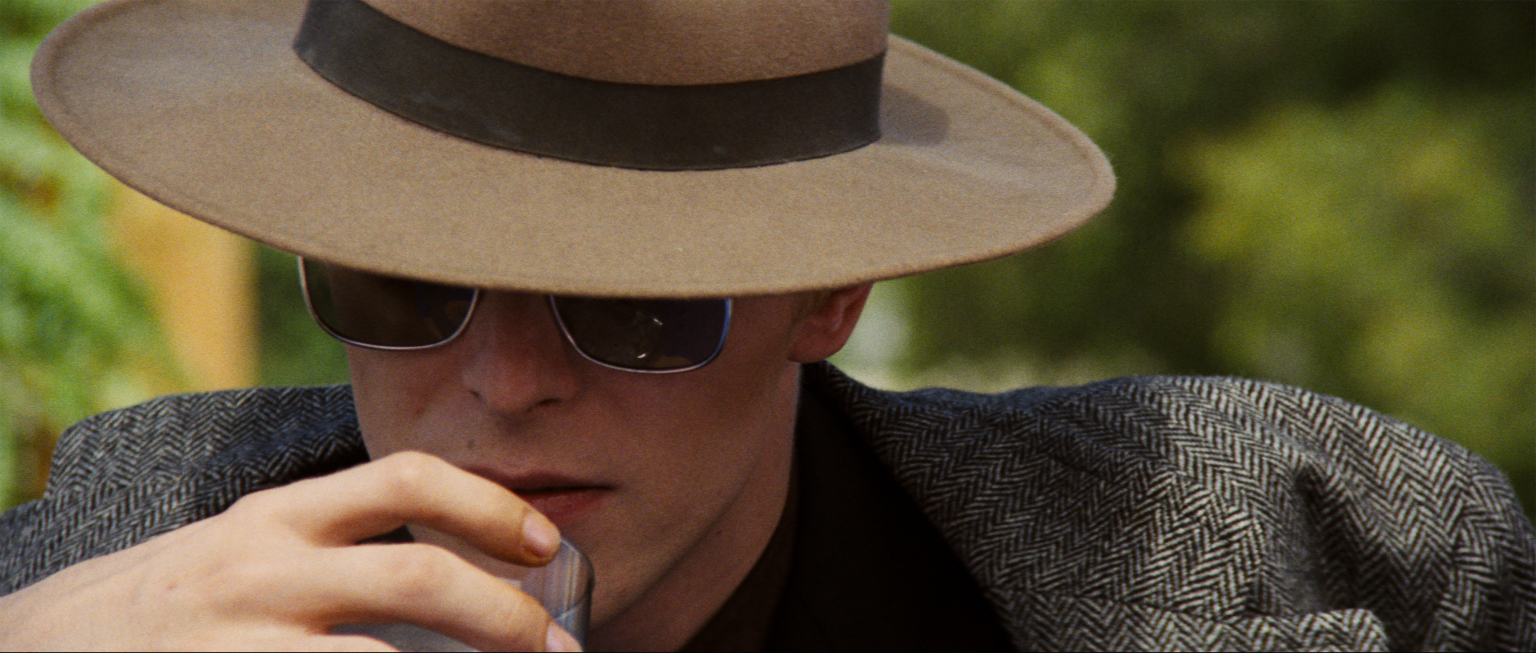
Chewed up and spat out, Bowie’s disillusioned alien is now trapped, an exile on Earth. He’ll see out his days wondering what could have been and, no doubt, being reminded – explicitly or otherwise – that the American Dream didn’t, in his case, work out. In a way, though, it did, at least by the standards of the prison that is also his home. He achieves more than 15 minutes of fame, and, after his gilded incarceration at the hands of the government intent on running tests, he finds a freedom of sorts. He even makes an album under the apt pseudonym, The Visitor (which, he hopes, will be heard via radio waves, by his wife). And, as he remarks to Bryce, the scientist who once worked for him: “I may not see so well anymore – [but] I still have money.”
Mirroring the fate of Newton’s parched Anthean world, with at least one isolated alien adrift (it is hinted throughout there have been more visitors like him), humans continue their search for new frontiers to conquer, rushing to meet their/our destruction, be it through climate change, nuclear war, or something else. In this, The Man Who Fell to Earth – greeted with mixed reviews and no little confusion on release – was prescient, and its poignance remains undimmed as the film marks its 50th anniversary.
A short coda to this, of course, is that unlike Newton, Bowie escaped his own American hell, Los Angeles and drug addiction, in the months following the film’s shoot (and subsequent release of Station to Station). Moving to Berlin, he would get clean and make three of the most critically acclaimed records of his career: 1977′s Low, “Heroes” (also 77), and Lodger (1979). The first of these Bowie had begun thinking about when working under the illusion that it had been agreed he would also provide the soundtrack to The Man Who. It, as with its cover art, it’s fair to speculate, owes more than a little to the experience of working on Roeg’s film.
Mike Pinnington
The Man Who Fell to Earth is in cinemas nationwide on 13 November. A 50th Anniversary 5-disc Collector’s Edition, including the soundtrack, a booklet featuring essays and a new interview with Candy Clark, follows on 16 November. The Collector’s Edition also includes the new 40 min documentary: Bowie & Roeg: Aliens in America.