Reading Ruscha
“This exhibition is a road trip, with Ruscha as the driver.” Stephen Clarke rides shotgun through Tate Liverpool’s Artist Rooms: Ed Ruscha…
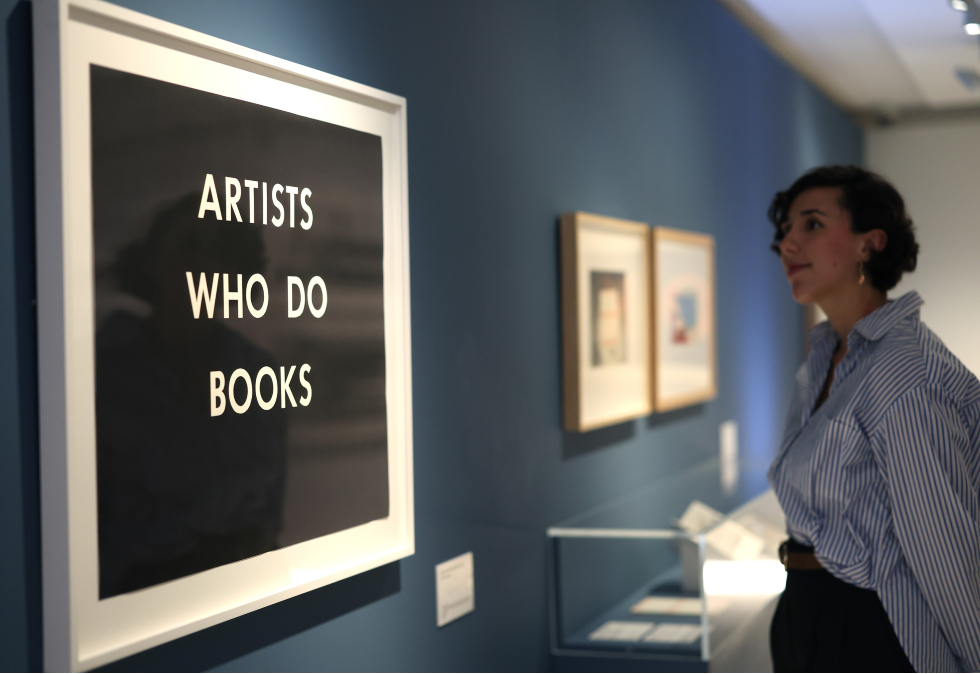
The text-based artwork, ARTISTS WHO DO BOOKS (1976), acts as the frontispiece to Tate Liverpool’s exhibition Artist Rooms: Ed Ruscha at RIBA North. The exhibition is a road trip, with Ruscha as the driver and his artist books acting as our guide. Our first stop is the seminal publication Twentysix Gasoline Stations (1963). This small book contains photographs taken by Ruscha along the highway, Route 66, between Los Angeles and Oklahoma. On a touch screen monitor next to its display case the viewer can leaf through a digital copy; and see other complete copies of seven of Ruscha’s classic books. These selected publications provide our itinerary, each one focusing attention upon the built environment – a suitable subject for a gallery at the Royal Institute of British Architects.
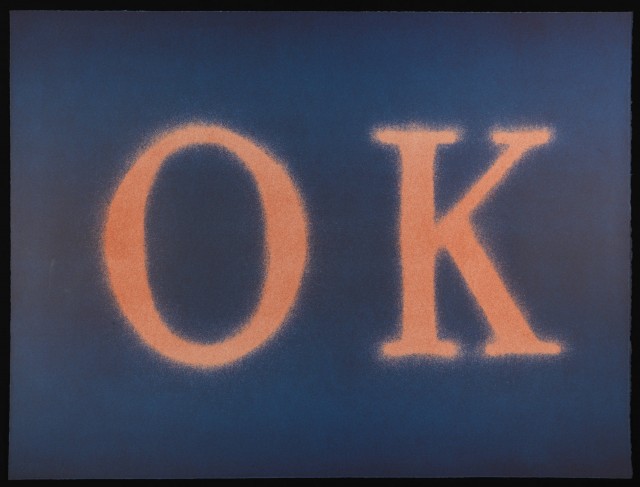
Tanked up on gasoline, we are on the move. Our route is punctuated by text-based artworks. The large letters OK (1990) suggest that it is okay to continue our journey and, perhaps, reference Oklahoma as OK is the state’s abbreviated form as it would appear on a vehicle licence plate. It is worthwhile noting that Ruscha is an ‘Okie’ – a migrant to Los Angeles who has had to learn how to read this city. Our next guidebook is Every Building on the Sunset Strip (1966), an accordion-format book that unfolds to nearly twenty-five feet in length. We literally have to travel along this continuous image – the viewers’ eyes in motion as the book is read. In the gallery, six photographic prints represent the Strip. On the negatives for the prints Ruscha has applied a razor blade and sandpaper to distress each picture. The result is that we become aware of the artist’s hand that disrupts our view through the car window.
The next punctuation point is another text-based piece, DANCE? (1973). This piece uses foodstuffs – coffee, egg white, mustard, chilli sauce, ketchup and cheddar cheese – to produce the letters that stain the canvas. DANCE? functions as a juncture between the diners and nightclubs pictured in the photographs of the Strip and invites the sort of physical activity that could take place in the next series of photographs of swimming pools from the artist book Nine Swimming Pools and a Broken Glass (1968). These pools seem to be the communal spaces of apartment complexes or, more likely, roadside motels. Motion is arrested as the still, uninviting pools wait for guests to arrive. Around the corner are photographs from Thirtyfour Parking Lots in Los Angeles (1967). It is a fanciful leap to consider drivers parking up to take advantage of the empty pools; however, both sets of work await intervention. The question function of Dance? becomes ‘Park?’ and ‘Swim?’
America, Her Best Product (1974) is the next punctuation and effectively introduces artworks that reference street maps. A set of aerial photographs of parking lots taken from a helicopter gives us the bird’s eye view or downward gaze that is the vantage point of the following painting and etchings. The painting BLVD. – AVE. – ST (2006), is dissected by thick pale bands across a light grey speckled ground which connotes the surface of the Los Angeles roads. The harshness of sunlight is apparent in the grey tones whilst a band of bright orange at the top of the canvas adds to the feeling of heat. This painting is supported by a group of small, coloured etchings that are comprised of lines and street names – reinforcing the reference to map reading. It is at this point in our journey that we move on to higher ground.
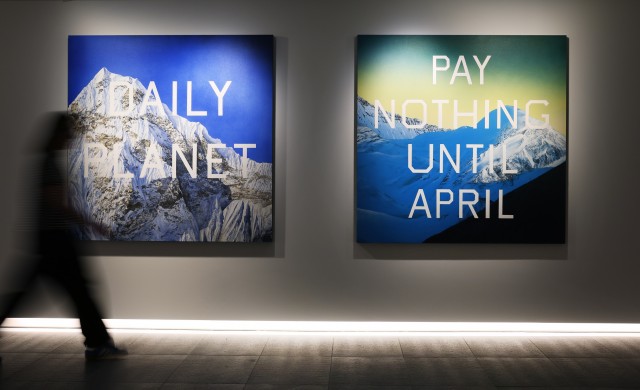
Snow-capped mountains that seemingly have no place in the hot desert of southern California are the background for two large paintings. These are overlaid with text: one reads DAILY PLANET (2002), while the other promises Pay Nothing Until April (2003). Are these billboard adverts that we drive past? A strong connection is made to the movie industry since The Daily Planet is the workplace of Clark Kent, and the snow-capped mountain is the logo for Paramount Pictures. At the close of this section the piece Miracle #64 (1975) depicts a strong shaft of light shining from the top left corner that cuts through the darkness of the background. It is often interpreted as a depiction of light emanating from a film projector, or alternatively a heavenly intervention; it could be seen more prosaically as the overhead light from a streetlamp.
The penultimate punctuation point is the word painting HONK (1962). Situated high on the wall, thus disrupting the flow, the piece breaks the silence of Miracle #64. At the close of this exhibition, references to the film industry take centre stage as the text pieces MAD SCIENTIST (1975) and HOLLYWOOD TANTRUM (1979) connote cinematic drama. Perhaps, the fate of the screenwriter was enacted by the minor drama of Royal Road Test (1967) – on display as a digital book – that documented Ruscha dropping a vintage typewriter from a speeding Buick. Did Ruscha take on the role of the scientist undertaking a mad experiment or was the typewriter thrown through the window as an act of aggression?
The exhibition closes with a final text-based artwork. THE END #40 (2003), is a depiction of the last few seconds of a movie, caught between frames. The two words, ‘The End’, are cut along the horizontal plane and so simulate the motion of the film. The dynamic of this exhibition has been the viewer moving through the landscape of southern California; however, the main concern has been the relationship between Ruscha’s books with his paintings, prints and photographs. The centrality of his publications is evident: it is clearly affirmed that Ruscha is the artist that does books.
Stephen Clarke is Senior Lecturer in Critical and Contextual Studies, University of Chester
Artist Rooms: Ed Ruscha continues @ Tate Liverpool until 14 June
Images: Edward Ruscha, ARTISTS WHO DO BOOKS 1976; Ed Ruscha, OK (State I) 1990. ARTIST ROOMS Tate and National Galleries of Scotland. © Ed Ruscha; Edward Ruscha, DAILY PLANET 2003 &PAY NOTHING UNTIL APRIL 2003