The Big Interview: Kristján Maack’s Glacier Portraits, and a Disappearing World
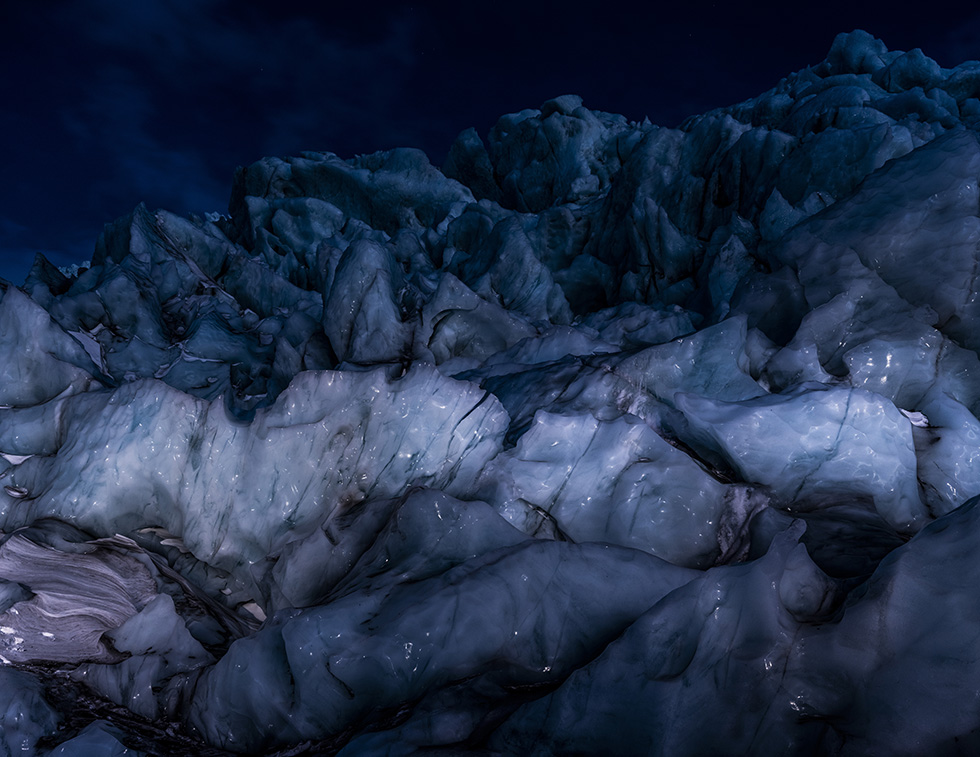
We know that they are melting, never to return. We know that they are so intrinsic to Icelandic culture that there is grief around their loss; a funeral was held for Okjokull, Iceland’s first glacier to disappear, and which once covered six square miles of deep ice.
Kristján Maack is one of those grieving for these centuries-old bodies of ice. A commercial and landscape photographer, born in the capital city of Reykjavík in 1967, Maack has been documenting Iceland’s epic glaciers for over 40 years, exploring them as an adventurous teenager as soon as he learned to climb.
Maack is currently exhibiting a series of epic glacier ‘portraits’ at Reykjavík Museum of Photography. Entitled Sleeping Giants, the project has taken six years to complete, working around dangerous conditions and seasonal melts. The resulting exhibition is a stimulating, emotional showcase of these landmarks as alive and shapeshifting – ultimately, towards a man-made demise.
Having visited the show, I was left with an overwhelming sense of the once steadfast turned fragile. The timeline is shocking – it has taken just a few decades to destroy what takes hundreds, even thousands of years to create. The Sleeping Giants are now waking, as Maack says. I had imagined melting as a quiet act, not the cracking, noisy and treacherous metamorphoses shown here.
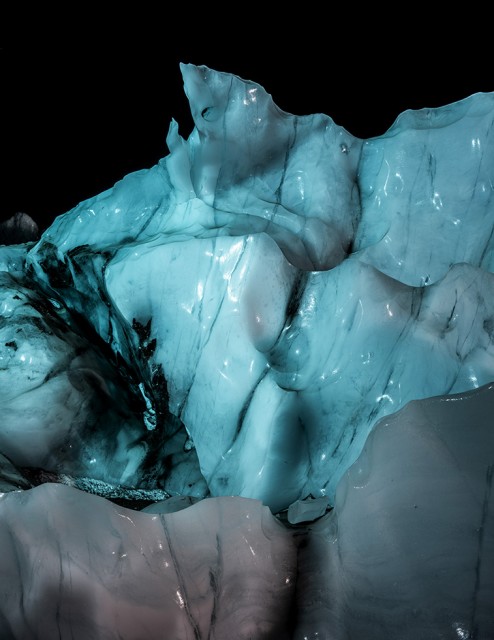
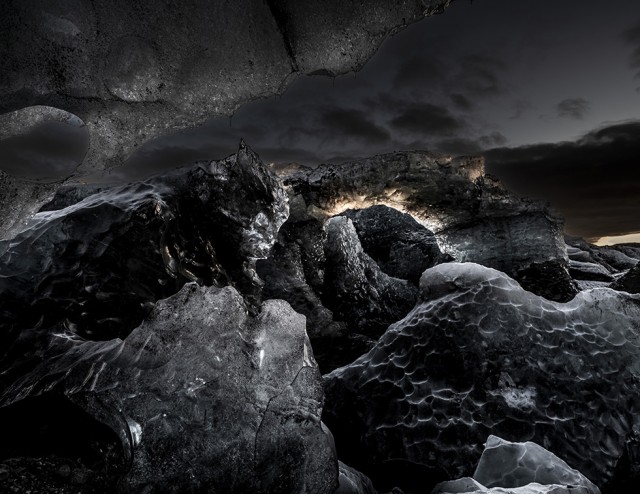
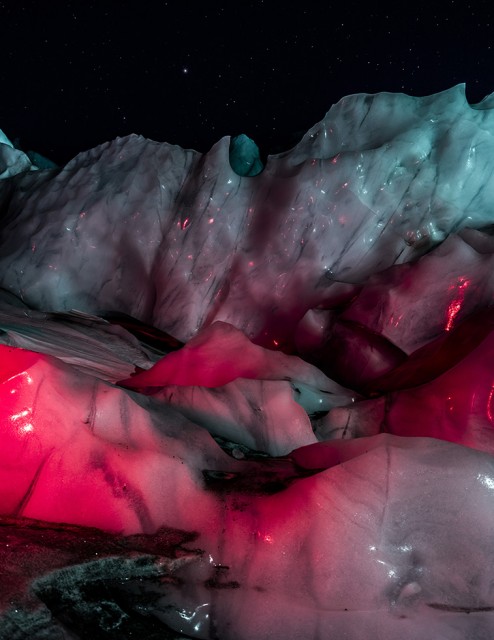
Maack’s evident love for the land comes across in sharp detail; ancient sediments carving black tiger stripes in ice cliffs; volcanic rock in a spectrum of pinks, purples and greens; sunlight illuminating the thin walls of ice caves; boulders slick with melted water and ready to crush anyone nearby. Field recordings play creaks and snaps of breaking ice floors.
A climber and skiing enthusiast, as well as volunteer mountain rescuer, Maack’s work reflects a deep respect for nature, and encourages others to see and reflect on the changes that are taking place in our time. Sleeping Giants displays glaciers and the connected landscape as undergoing radical transformations, in the here and now. “Something”, he comments, “our generation is only now beginning to fully realize.” He predicts that the glaciers will last no longer than two more generations; that his grandchildren will be among the last people to see them in person.
For UN World Day for Glaciers on 21 March 2026, Maack will host a symposium at the exhibition in collaboration with the Icelandic Glaciological Society, The University of Iceland and the Icelandic Meteorological Office. In its Northern location, crossing over into the Arctic Circle, Iceland is seeing alarming signs of rising temperatures (mosquitos have been recorded for the first time in its history). What – given the county’s popularity as a holiday destination – can be done to halt the melt? What can be done to counter, or wake up, audiences from a hopelessness, even apathy, regarding the relentless march of climate change?
Laura Robertson: As you recognize in your current exhibition, Sleeping Giants, people feel… Helpless towards climate change. They don’t even really know where to start.
Kristján Maack: Exactly, it’s a big task. But you can start with thinking about it, and you can start to educate your children, or the next generation in schools, and just slowly.
You’ve spent your life on the glaciers.
Part of my hobby and my other life, yes.
What it’s been like, from childhood, having a relationship with this special landscape?
It’s been a beautiful thing. My first plan was to live abroad when I studied photography 40 years ago in the US, and I was thinking, I need to be in a bigger market. But after five years in California, I couldn’t be without Icelandic nature. I had to come back.
Of course, there’s a beautiful nature everywhere, but it didn’t talk to me the same way. So, I moved back in 1994, I’ve been here ever since, and using the nature and the mountains and the backcountry to reenergize from my daily work, which is a commercial type of photography. In the later stages of my career, I decided, no, I want to focus on this, to use my experience and talent, you know, to speak to people above this place, and try to help it to survive.
We don’t know how it’s going to be in the future. But the graph is always showing, you know, it’s getting warmer. I didn’t see myself as an activist. Never. It wasn’t until I sat down and, focused. So, maybe that’s what people have to do. Sit down and focus. How do you respect the nature? Do you want to use it? What can you do?
What are your views on the current dialogue on climate change?
Climate conferences, international conferences, COP… we have those here in Iceland, there’s Arctic Circle. It costs so much money to take part, and there’s a lot of politics, and I don’t know, it’s not about the nature, it’s about something else.
I don’t think that as a nation, or our policy, or politics, they cannot make changes towards or regarding those big companies. I don’t think that’s going to happen, because it’s all about money and business, and they find a way around whatever they need to do.
But things are changing regarding energy. Renewable energy sources are more common than they used to be, which I think is good, and I see that all around us here in the northern hemisphere, in Norway and Iceland, of course, and most of the Nordic countries are using more electricity that they produce in a kinder way than the fossil fuel. We can do that, because the technology allows it, and it’s good business, also.
I was recently reading about Uruguay. They hired a physics professor as Energy Secretary, five years ago, and now the country is operating on 99% renewable energy. So, it is possible for society to make huge change.
Correct, yeah, that’s what it takes, and that’s the reason I believe that other mediums, like art, like physics, can persuade politics, and the general public, towards the right thing to do. We have to use other mediums than just lectures, reports, news, and hard facts. They are not only tools in getting the message out.
I’m trying to open this window with photography, and have people, just normal people, talk about those things.
UN World Day for Glaciers on the 21st March – what a perfect moment to have an in-depth discussion about glaciers.
We’re opening up the Reykjavík Museum of Photography, and we’re planning a panel from the scientific community, people from the university, the weather office of Iceland, and The Iceland Glaciological Society, which is a union of volunteers that are interested in the health of the glaciers, since 1950. Every year they measure the glaciers. I’ve got people from the tourist industry also to participate, who are becoming the biggest users. Like, every day there are a thousand tourists on the glaciers.
Fumes from transport. Leaving rubbish behind.
And, so we need to take that in concern. Who are the users today? They’re not farmers, not locals, they’re tourists, who go there frequently, and we have to observe what their needs are, and make sure they’re safe. And make sure they’re not changing the way of the nature, which they are doing right now, because those smaller companies that take tourists there every day, have crews of workers with shovels and ice axes to chip out bigger doors to the ice caves. It’s going to melt anyway, you can think of that, but still, it’s…
Probably not helping.
No, it’s not helping, and it’s not… shouldn’t be like that. If we’re showing the nature, show the nature as it is.
Exactly. And, you know, tourism is a contentious point, isn’t it? Because some areas of natural preservation across thew world have fallow years when nobody’s allowed access.
Yes.
So, it has time to recover. I noticed on my recent trip, most visitors are being respectful, but some tourists are ignoring warning signs, jumping over barriers. My Instagram is full of video footage of tourists trampling all over delicate locations, ancient moss that will take a hundred years to grow back. One hundred years!
Yeah. The geothermal areas which have clay-like surfaces, and the clay is damp, and they just walk right across it and leave footmarks everywhere. So, the next person that comes there and wants to photograph it, like myself, it’s all footmarks you can see. We don’t have the infrastructure to market, to put more signs. We’re just struggling to get the toilets out to remote locations, you know?
The tourism is so enormous in Iceland and growing. I hear that the ratio of tourists to residents is really stark.
Like, one resident to 5 tourists.
What will be the long-term impact of this intense tourism? How will Iceland proceed in the next 5 to 10 years with managing this?
It’s hard because we need time and, of course, money to build up the infrastructure and have people at those remote places to advise visitors how to behave. We simply don’t have enough people to work in the hospitality and leisure industry.
When you actually get out there, with all your kit, what is it like to be on the glaciers at night? Because it sounds dangerous.
It is scary, because the night brings in another element than the daylight. They break and they move. And, so if you come there a week later, it’s a totally different scene. Especially the noises.
The sound in your exhibition is astonishing. Sitting in the listening room, hearing the filed recordings of glaciers move… It sounds like the floor beneath you is about to split and break.
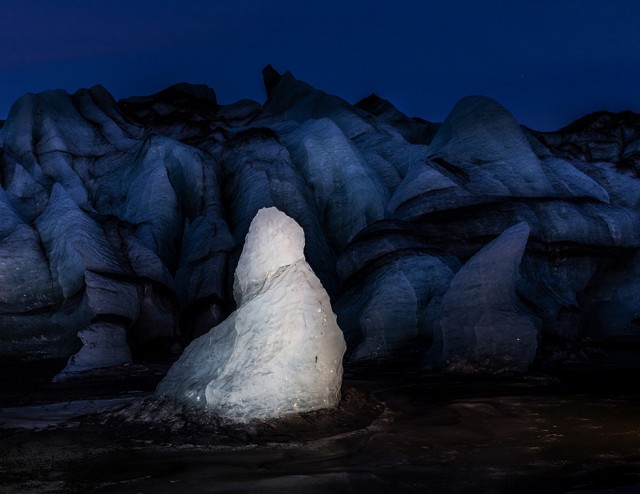
You cannot pinpoint the direction of the sound, even when you lose your eyesight because of the darkness. Your ears and your other senses start to work harder, to figure out what’s going on, placing those sounds, and you’ll start to look around. With your flashlight on your helmet or on your hand, and you start to figure out where’s the sound coming from. [In making this series of images for Sleeping Giants] I looked to the right, and I saw a figure looking at me, you know, ice structure to the right, and ice structure to the left, and that’s how the glacier was speaking to me.
And, so the sound is really important, and that was the only thing I was afraid of. I was not afraid of walking, because I feel comfortable. I’ve been teaching ice climbing and ice walking with equipment for many years, and doing a lot of traveling all over the world. But the noise, you never get used to that.
Nature’s warning? You can imagine how this was interpreted centuries ago. I went to see an exhibition of folklore at Reykjavík’s House of Collections, and one of the prints there depicted the story of a human accidently running into a troll – and if a troll says something to you, you must answer immediately or die! Like the glaciers, perhaps?
Yeah, that’s nice [laughs]. But, usually those stories, folk stories, they’re mostly about nice trolls, nice elves… so I consider those my friends [laughs]. The glaciers are hostile, of course, because it’s dangerous to be very close when they fall and break, but in a certain time of year, it is safer to approach them. Summer is the most dangerous season, especially if the weather is, like, very rainy and wet and not as cold.
So, I tried to go out on a mission, to photograph, when the weather was extremely cold, the wind was low, and that narrowed it down to maybe three weeks a year. That’s why it took six years to make Sleeping Giants, until I felt good about this project.
Can you tell me about the locations you shot Sleeping Giants in?
All of them are on the South Coast of Iceland. More prone to weather changes, because all the warmer climates come from the South to this island, so they are very fragile, and they change frequently. They’re very accessible from the roads, from the mountain to the shoreline. They are all part of volcanic systems: there are volcanoes underneath those glaciers.
It’s so complex, isn’t it? You would never think, from just looking at the extreme heat and cold, that these systems were connected underneath.
Exactly. And it’s quite a spectacle. It’s very beautiful to see when an eruption starts from underneath a glacier. I remember Grímsvötn Vantnajökull; it was a big eruption on the middle of a glacier. I went flying on a small airplane with my brother, photographing. And then, a few days later, we decided to drive on a big truck to top of the glacier towards the eruption. It was like a flat snow field towards it for many, many kilometres. We drove there for maybe, I don’t know, 12 hours.
And then we came to a scientific research hut, like a small cabin on top of the glacier. We stayed there overnight, but what happened during the night was the ash from the volcano, had spread all over the white snow fields. Everything was black, and all the tire tracks on the snow were white. Like a Double Negative.
Indeed [laughs]… Iceland is one of the countries where you can see these extremes of landscape, and geological violence, spectacle.
Another project I told you about a little bit in my lecture when you visited me at the Museum, is an old volcano that you can go into, Þríhnúkagigur. I photographed the whole interior of it. It’s quite colourful. It is, for me, pretty much the same as the glaciers, it’s just, different material. It behaves the same, a molten lava that solidifies and gets a certain texture, and all the minerals create the colours.
In the exhibition, I was struck by your many photographs of ice caves. I remember asking you, is that the actual colour? Because it showed an incredible range from white, to blue, to purple, to black.
Very surprising, and that you could see the sunlight through them as well. The light penetrates through many, many feet of ice.
Well, I thought it was artificial light that you’d brought to these night shoots, but of course it was the sun, shining through the walls, which is incredible.
Yeah, and it has to do with the photography technique, long exposure. It’s sometimes it’s not noticeable to the human eye. The colours in the volcanic stone come from minerals, iron ore, silica, and the whole spectrum of colour quality. It’s very unexpected.
It’s good to play with colour and provide a bit of dramatic tension in the shots, because it’s another tool to get people to think about what it is they’re really looking at.
I think, art or photography, are the perfect ways of communicating. Because it allows you to express so many things.
Laura Robertson
All images courtesy Kristján Maack
See Sleeping Giants the exhibition at Reykjavík Museum of Photography until 5 April 2026
The Symposium: UN World Day for Glaciers will take place from 2pm on 21 March in collaboration with the Icelandic Glaciological Society, The University of Iceland and the Icelandic Meteorological Office